NanoLynQ Advanced Materials — a division of ARES Industrial Corp.
Graphene-enhanced additives for all oil and gas including heavy oil.
NanoLynQ develops and commercializes advanced additive chemistry for the failure modes that define oil and gas operating cost, heavy oil above all: paraffin deposition, stubborn emulsions, EOR, recovery limits and internal corrosion.
NanoLynQ uses a self-developed software called NanoLynQ IQ, an owned AI app to manage lab work, analysis, mixing, formulations and development.
Available now
Products ready to go.
Formulations past development and available for supply today, with injection equipment and dose control included in the program.
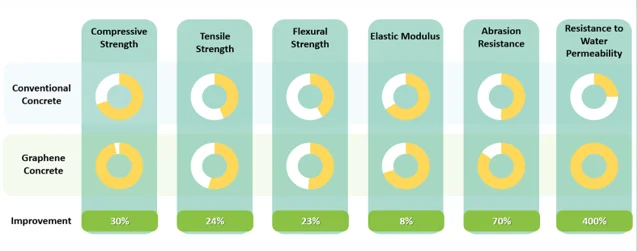
Construction GO testing results — University of Melbourne
In supply
GO additive for concrete supply
Graphene oxide admixture for structural concrete, dosed at the batch plant to raise compressive and flexural strength and cut permeability in foundations, piles and slabs.
Batch-plant dosed · mix designs on request
In supply
GO additive for cement applications incl. 3D printing and stucco scratch coats
Graphene oxide admixture for cementitious mixes, improving crack resistance, adhesion and water repellency.
Site mixed · mix designs upon request
In supply
GO additive for oil/gas wellbore cementing
Graphene oxide admixture for drilling and wellbore cement, improving bond strength, zonal isolation and resistance to cracking and gas migration.
Site mixed · mix designs blended to your program
R&D application areas
Six development tracks, each aimed at a cost we already see in the field.
Paraffin control
Additives targeting wax crystal formation and deposition in tubing and flowlines.
Target: fewer hot oil and cutting interventions
Emulsion treatment
Interface-active chemistry for tight heavy-oil and SAGD emulsions and slow-resolving water cuts.
Target: cleaner separation, lower treating cost
Enhanced oil recovery
Mobility and interfacial-tension work aimed at incremental recovery from mature heavy-oil and oil sands pools.
Target: incremental barrels from existing wells
Asphalt binders
Graphene-modified asphalt binder for lease roads, pads and industrial paving, aimed at rut and crack resistance through freeze-thaw and heavy haul traffic.
Target: longer surface life of asphalt roads
Produced water treatment
Nano-enhanced treatment for the water side of heavy oil, targeting suspended solids, residual hydrocarbon and scale precursors ahead of disposal or recycle.
Target: cleaner water, lower disposal cost
Corrosion & sensory development
Graphene-based sensing layers paired with the protective chemistry, so corrosion, wall loss, temperature and process drift report themselves instead of surfacing as a failure.
Target: condition data from the asset itself
Why graphene
Surface area is the mechanism.
Graphene-family materials carry enormous surface area per unit mass and can be functionalized to sit at the interfaces where heavy-oil, SAGD and oil sands problems actually live — the wax crystal, the water droplet, the pipe wall.
The engineering work is dispersion stability, carrier compatibility and dose economics at field temperatures. That is where our development effort sits, and it is validated against measured production data rather than bench claims.
Formulation and dispersion development
Field trials on live systems, with a measured baseline
Producer and supplier partnerships for scale-up

Graphene, AlexanderAlUS / Wikimedia Commons, CC BY-SA 3.0

Development status
R&D trial partners wanted.
NanoLynQ products are in active development toward commercialization. We are looking for producers willing to run instrumented field trials on problem systems — the kind where paraffin cutting, hot oiling or emulsion handling already carries a known monthly cost.
Trial partners get the program at development terms and the measured results, whichever way they land.